
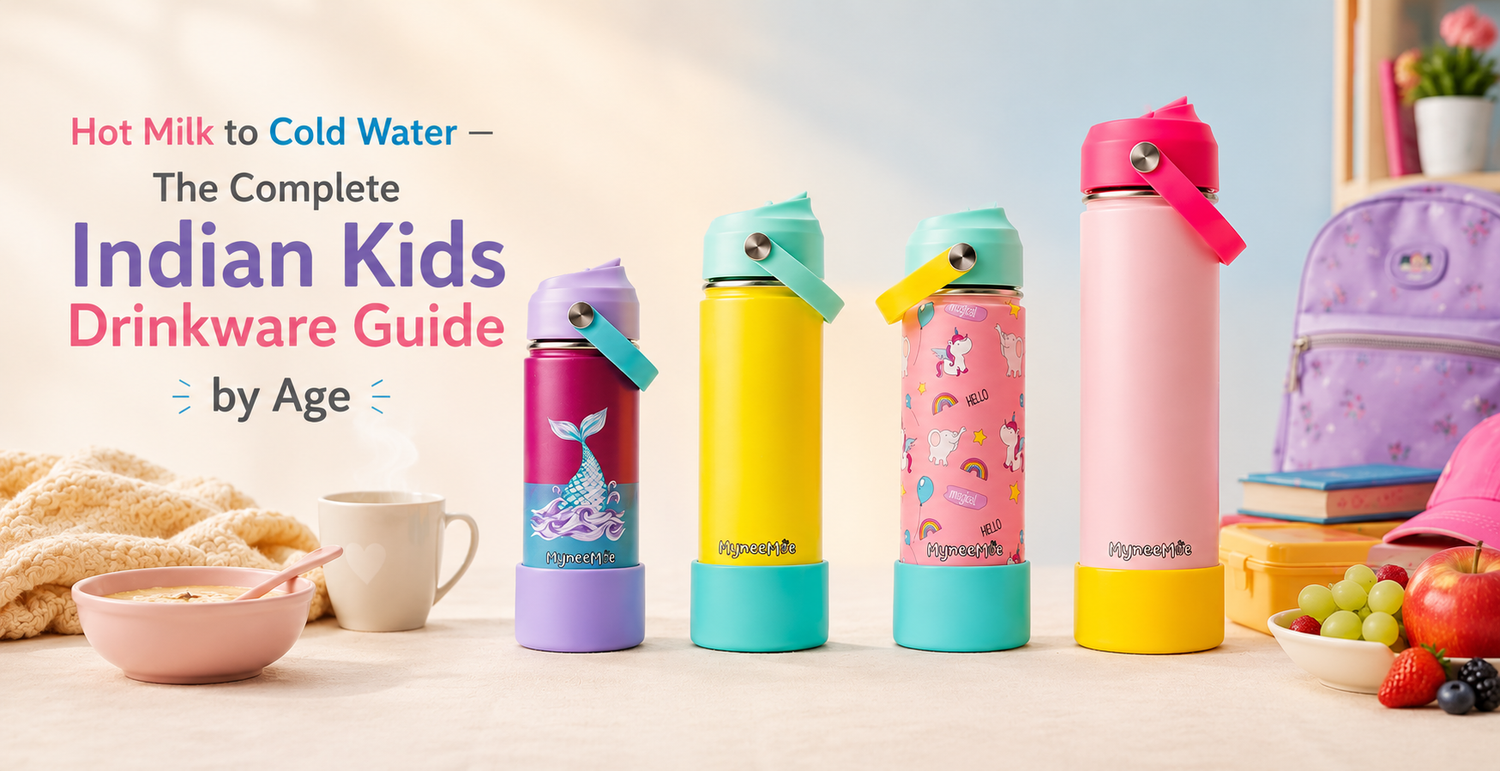
Not all children drink in the same way; what works for a toddler will not be appropriate for a child aged 10 years old. There is more to choosing the right drinkware than personal choice. Safety, spillage, and ensuring that your child drinks enough each day depend upon having the right equipment at the right times.
Being the parent of an Indian child involves balancing many factors in order to ensure proper hydration. Whether it is morning milk before school, drinking water in the water bottle, or hot soup or juice during the cold winter months, each beverage requires a particular type of drinkware. Choosing the wrong type of drinkware can lead to accidents and spills. This guide shows you how to choose correctly according to the age of your child.
Why Drinkware Choice Changes with Age
Three main transformations happen as the child ages:
-
The younger kids need simple designs, while the older kids can use the screw-top lid and flip-top lid
-
The toddlers need the warm milk, while the older kids need the cold water and maybe some hot drinks
-
Your kid needs the accident-proof design when he is 3 years old, but at age 10, all he needs is portability
By choosing drinking vessels according to their stages, you'll have reduced chances of accidents and improved hydration.
Age 0–1: Feeding Bottles and Soft Spout Sippy Cups
At this stage, everything is about softness and control.
Babies in the infancy stage feed using standard feeding bottles, silicone or latex nipples that flow slowly for the baby to digest better when young, but at an increasing speed as the child develops. This stage is well understood by many parents who consult their pediatrician.
Starting at the age of 8-12 months, you can start using a soft-spouted sippy cup, which features:
-
A soft silicone spout, similar to bottle feeding
-
Grips on two handles
-
Slow flow valve, preventing swallowing in one gulp
The volume should be small, not exceeding 60-90ml at one time; water and diluted juice only, milk is provided in other ways.
Age 1–3: Transitional Sippers and Straw Cups
This is where the real transition begins.
A sipper bottle for kids in this age range should prioritise spill-proof design above everything else. Toddlers tip, throw, and drop; the bottle needs to survive all three.
Look for:
-
360-degree spill-proof lids: drinks from any angle, no tipping required
-
Cups with straws that have weights attached: the weight of the straw moves with the fluid
-
Handles or grips: small hands require something to grasp
-
Plastic BPA-free or stainless steel: anything with no sharp corners or heavy lids
Capacity: 200–300ml is enough for this age. Anything larger and they won't finish it.
Warm Milk on the Go
For toddlers who still take warm milk in the morning or at bedtime, a small stainless steel insulated bottle works well. It keeps milk warm for 2–3 hours without overheating. Avoid plastic for warm liquids at this age.
Age 3–6: Sipper Water Bottles for Preschool and Early School
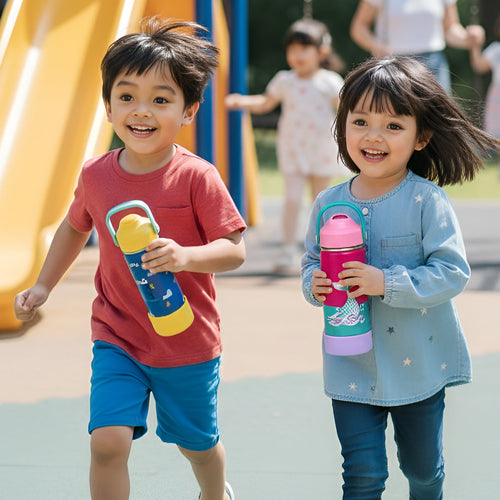
By nursery and KG, most children are ready for a proper sipper water bottle for kids, one they can open and close independently.
The best options for this age:
-
Straw bottle with flip-top lid, just one press to open the straw, another to close it. Easy, spill-proof, manageable even for tiny hands
-
Stainless steel body, sturdy enough for bag use in pre-school classes
-
Size: 350-500 ml, sufficient for half-day school sessions
Age 6–10: Steel Water Bottles for Primary School
Primary school kids need something tougher. Bags get thrown, bottles get knocked off desks, and lids need to survive the chaos of a school corridor.
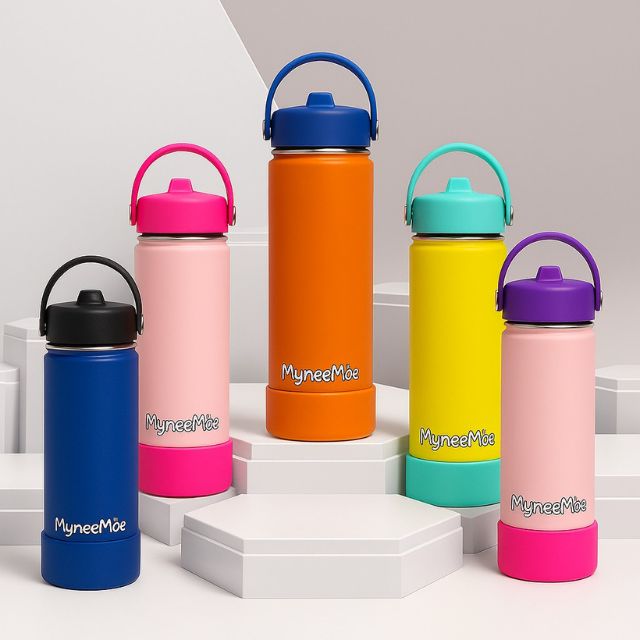
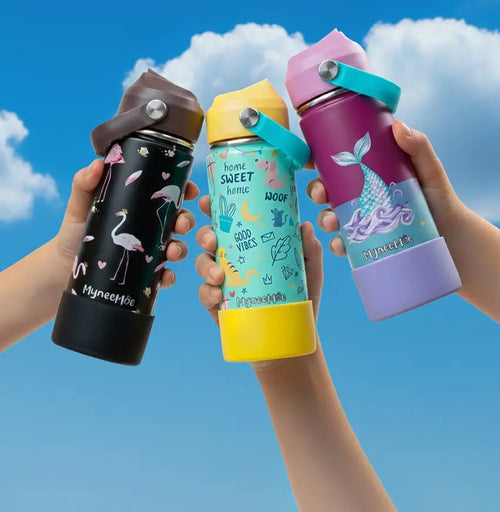
A steel water bottle for kids is the best choice from Class 1 onwards:
-
Dents less than plastic cracks
-
Remains cooler for longer, which is vital in the hot Indian summers
-
Does not stain, does not affect taste or cause odors, nor does it leach chemicals
-
Large enough to facilitate thorough cleaning
Capacity: 500-750ml, sufficient for a whole day at school.
For kids who carry warm milk or soup on cold mornings, a small thermos flask for kids is worth adding to the kit. A good insulated flask keeps liquids warm for 5–6 hours, perfect for a school bag.
Age 10–14: Thermos Flasks and the Transition to Grown-Up Drinkware
These teenagers or children, just out of pre-teens, have reached an age where large mugs are suitable for them. They are capable enough to handle screw-on lids, understand that a thermos should not be dropped, and develop their own preferences.
The best thermos flask in India for kids at this stage should offer:
-
Double-wall vacuum insulation keeps cold drinks cold for 12+ hours, hot drinks warm for 6–8 hours
-
Wide-mouth opening, easy to clean and fill with ice
-
Leakproof screw cap, secure enough for a school bag
-
Capacity: 500ml–1 litre

Some slightly older children will begin to ask for something warm to drink upon waking up, especially during wintertime. A smaller-sized kids coffee mug, which should really be used to drink things like hot cocoa or milk, is ideal for on-the-go use. The best option is a double-wall design made of stainless steel.
Conclusion
The proper drinking container is not just a vessel for storing liquid but also one that promotes independence and proper hydration while enduring the rigors of childhood use. Picking the proper drinking container based on your child’s age and what they will be drinking ensures fewer spills and mess.
Here, you will find kids water bottles, sippers, and insulated flasks that have been specially crafted for little Indian children, who will benefit greatly from these durable and safe products. Choosing the right drinkware may seem like an insignificant choice, but it can really simplify your daily routine.
FAQs
Q1: At what age can kids switch from a sippy cup to a regular water bottle?
The majority of children have the ability to use a spout cup by the age of 3–4 years old. It is at the age of 6–7 that a wide-open mouth bottle can be used because fine motor skills have been established.
Q2: Are steel water bottles safe for young children?
Certainly, stainless steel is among the safest types of material that you could use to make your kid's drinking bottle. It does not leach any substances, nor does it absorb any smells. Steel bottles should be light and small for toddlers below three years old.
Q3: Won't a thermos flask be too heavy for a school bag?
This is dependent on the capacity of the thermos. If it’s a 500 ml stainless steel thermos flask, then it will weigh between 250 g and 300 g without any liquid inside. This weight should not be too heavy for children aged 10 years and above.
Q4: Is it okay to put warm milk in a stainless steel sippy bottle?
Yes, stainless steel is safe to use for warm beverages. However, for optimal performance, it is better to choose an insulated bottle than a non-insulated one. The reason behind that is that using an insulated bottle ensures that the milk remains warm for a long period.
Q5: Can I put juice or flavoured drinks in a steel water bottle?
Yes, but rinse it thoroughly after each use. Sugary or acidic drinks like juice can leave residue that causes odour over time. Wide-mouth steel bottles are easier to clean properly after anything other than water.